Chinese EV OTA Updates & Infotainment Localization: A B2B Sourcing Guide
How B2B importers can solve infotainment language barriers, OTA restrictions, and app ecosystem compatibility when importing Chinese hyper EVs.
OTA Updates & Infotainment Localization for Chinese EV Imports
When parallel importing high-performance Chinese EVs (Hyper EVs) such as the Zeekr 001 FR, Xiaomi SU7, or Yangwang U9 to international markets, mechanical reliability and charging compatibility are only half the battle. The most immediate point of friction for end-users—and the highest liability for B2B distributors—is the software ecosystem.
Because these vehicles are engineered first for the Chinese domestic market (CDM), their infotainment platforms are deeply integrated with Chinese telecom networks, localized mapping solutions like Baidu Maps or AutoNavi, and domestic app stores. For B2B procurement teams, failing to secure a reliable localization strategy means delivering a premium vehicle with a compromised, frustrating, and potentially unsafe user experience. The global expansion of Chinese hyper EVs has highlighted a significant gap between hardware readiness and software adaptability across different regulatory and linguistic regions.
This guide explores the technical boundaries of infotainment localization, the risks of "gray market" firmware flashing, and how to structure your procurement agreements to ensure reliable OTA (Over-The-Air) updates. We will delve into buyer decision points, supplier communication standards, and the failure risks associated with improper software modification, providing a comprehensive roadmap for enterprise importers and fleet operators.
Scope note (published July 25, 2026): This guide is written for B2B importers, fleet operators, and export engineering teams evaluating China-domestic high-performance EVs for global markets. It is not legal or homologation advice; final registration, data-transfer, and software-update requirements must be confirmed with the destination-country authority, insurer, OEM, and local counsel before shipment.
The Core Software Challenge in Cross-Border EV Trade
Chinese Hyper EVs operate as "smartphones on wheels." The hardware architecture is inextricably linked to the software layers, often utilizing centralized domain controllers that manage everything from battery thermal management to the infotainment display. The localization challenges fall into several critical categories that demand rigorous engineering and procurement scrutiny.
1. Language & Interface Barriers
Many CDM models default strictly to Mandarin Chinese. While some brands allow an English toggle within the user interface, this feature is often incomplete. It frequently only translates top-level menus, leaving critical system alerts, ADAS (Advanced Driver Assistance Systems) warnings, voice assistants, and deeper configuration sub-menus entirely in Chinese. This linguistic mismatch is not merely an inconvenience; it presents a severe safety hazard if the driver cannot comprehend immediate auditory or visual alerts regarding vehicle dynamics or system faults.
2. Connectivity, Navigation, and Telecom Ecosystems
The telematics control unit (TCU) in these vehicles typically relies on built-in SIM cards (eSIMs) that are hardware-locked or firmware-provisioned to Chinese carriers (e.g., China Mobile, China Telecom). Consequently, internet-reliant features fail when the vehicle is exported. Furthermore, the GPS modules and routing algorithms heavily depend on domestic cartography services like Beidou and Baidu Maps, rendering local navigation platforms (like Google Maps or Waze) completely useless overseas. Overcoming this requires either sophisticated hardware bridging or OEM-level API access to swap the mapping provider.
3. OTA Updates and Compliance Firewalls
Over-The-Air updates are the lifeblood of modern EVs, providing continuous improvements to range, safety, and infotainment capabilities. However, OTA servers are typically geo-fenced to mainland China. Overseas IP addresses may be blocked by the Great Firewall or by the OEM's internal security protocols. In many instances, initiating a critical firmware update requires a verified Chinese cellular phone number to receive an SMS OTP (One-Time Password). If a B2B importer cannot guarantee a pathway for continuous updates, the vehicle rapidly depreciates and may become susceptible to unpatched cybersecurity vulnerabilities.
4. Data Privacy & Geo-Fencing Risks
Exporting connected vehicles raises significant data sovereignty issues. Vehicles may transmit telemetry, location, diagnostics, account, and connected-service data back to OEM servers. For importers operating in jurisdictions with strict privacy and cross-border transfer rules (such as the EU's GDPR or Middle East data protection frameworks), unrestricted data flow to overseas servers can create legal and commercial liability if there is no lawful basis, consent path, transfer mechanism, or user disclosure. Understanding the applicable boundaries of data transmission and enforcing localized data minimization is a critical buyer decision point.
Localization Strategies: A B2B Procurement Decision Matrix
Importers typically choose between several distinct solutions to localize the user experience. Each comes with specific cost implications, engineering complexities, and compliance trade-offs. B2B buyers must weigh these options carefully against their warranty obligations and local homologation requirements.
| Localization Method | Implementation Complexity | Warranty Risk | OTA Update Compatibility | Cost Implications | Recommended For |
|---|---|---|---|---|---|
| Native OEM English Support | Low (Menu Toggle) | Zero Risk | Fully Supported | Included in base cost | Global-spec variants or OEM-partnered exports |
| Hardware Module (CarPlay/Android Auto Box) | Medium (Plug & Play / Minor Wiring) | Low to Medium | Supported (Does not touch base OS) | $150 - $400 per unit | Fleet operators needing fast, safe localization |
| Middleware / Virtual Machine Emulation | High (Requires custom software layer) | Medium | Partially Supported | High R&D investment | Enterprise distributors with in-house software teams |
| Third-Party Telematics Replacement | Very High (Hardware Swaps) | High | Usually Broken | $1,000+ per unit | Niche engineering firms doing full homologation |
| OEM Partnered Localization API | Medium (Authorized Developer Key) | Zero Risk | Fully Supported | Negotiated enterprise licensing | Large-scale enterprise leasing companies |
| Root/Firmware Flash (Gray Market) | High (Requires OS Exploit) | Very High (Voids Warranty) | Broken / high bricking risk | Variable | Strictly Not Recommended for any B2B buyer |
Data Note: Rooting or flashing CDM firmware to "Global" ROMs is highly discouraged, as it often disables advanced ADAS features and violates UNECE R156 software management standards. The failure risks associated with unauthorized flashing far outweigh any short-term localization benefits.
The Risks of Firmware Flashing and Reverse Engineering
Many unauthorized exporters and gray-market brokers offer to "flash" the vehicle's firmware to English before shipping. Procurement teams must vehemently reject this practice in all supplier communications and purchase agreements.
Flashing typically involves exploiting a vulnerability in the vehicle's telematics control unit (TCU) or the central infotainment screen to gain root access and overwrite the base operating system with a modified, translated ROM. Once this unauthorized flashing occurs, several catastrophic failure risks are introduced:
- Severed OTA Connection: The vehicle can be disconnected from the OEM's official OTA server. It may no longer receive critical safety patches, battery management system (BMS) optimizations, or autonomous driving enhancements through the supported update path.
- Cryptographic Bricking Risk: The next time the car attempts a legitimate OTA update - or if a diagnostic tool is connected at a service center - it may fail the cryptographic signature check. Depending on the OEM architecture, that can trigger a rollback failure, disable safety-critical software updates, or leave the vehicle immobilized until the original firmware is restored.
- Safety System Degradation: Critical safety alerts, such as thermal runaway warnings, automatic emergency braking (AEB) system faults, or steering column malfunctions, may not translate correctly or may fail to trigger altogether in the custom ROM. This leads to severe liability for the importer if an accident occurs due to a suppressed warning.
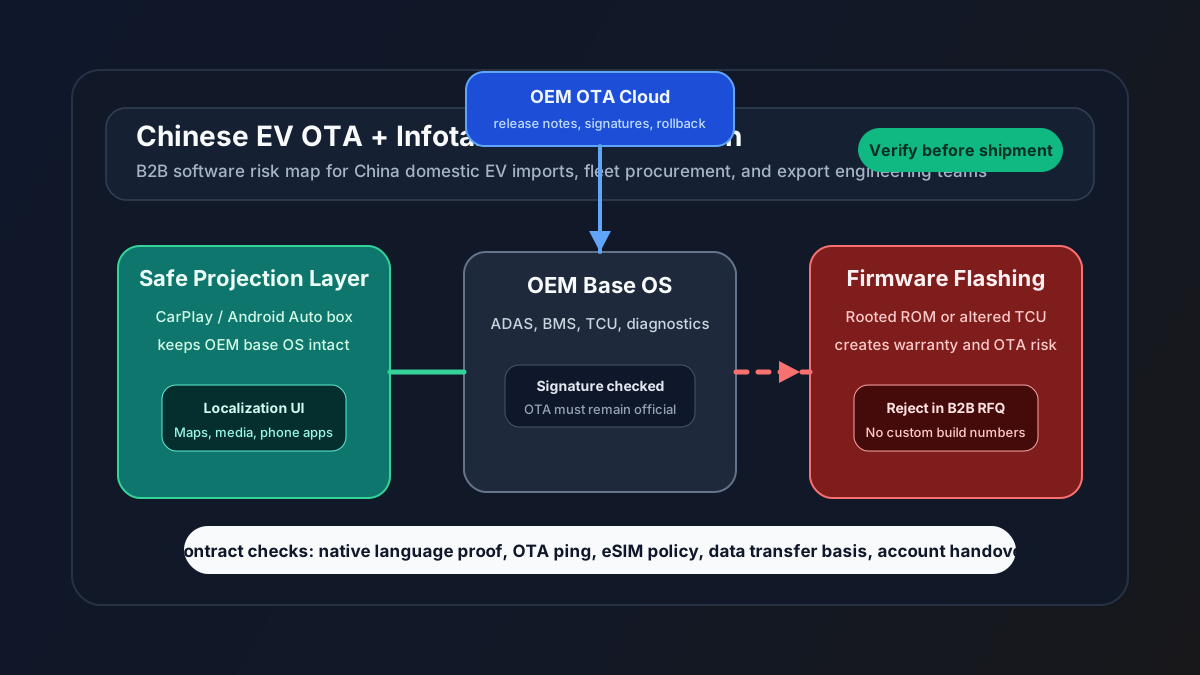
Architecture: Hardware Interface vs. Base OS
To understand why flashing is so dangerous, buyers must understand the difference between projecting a safe UI (like CarPlay) and altering the base OS.
Safe Localization vs. Dangerous Firmware Flashing
Regional Applicability and Compliance Boundaries
Localization is not merely a technical challenge; it is deeply intertwined with international regulatory frameworks. B2B buyers must navigate these compliance boundaries before importing a single unit.
1. UNECE R155 and R156 Regulations: For markets adopting UNECE regulations (including Europe, Japan, and parts of the Middle East), vehicles must adhere to strict cybersecurity (R155) and software update management (R156) standards. Modifying the firmware to achieve localization can invalidate the documented software lifecycle and cybersecurity evidence that the OEM or approval holder relies on. An illegally flashed vehicle may fail type-approval, inspection, warranty, or registration review in these jurisdictions.
2. Data Privacy Frameworks: When localizing connectivity, importers must ensure telemetry data routing complies with local laws. The European Union's General Data Protection Regulation (GDPR) requires a lawful processing basis, transparency to the driver, transfer safeguards for personal data leaving the region, and enforceable rights for data subjects. If the Chinese OEM's native OS continues to send personal or location data overseas without the required disclosure, consent path, or transfer mechanism, the importer may inherit regulatory and customer liability. Similar data sovereignty rules are emerging in the UAE and Saudi Arabia, making OEM-partnered API localization or documented data minimization the lower-risk long-term strategy for these regions.
Procurement Checklist: Supplier Software Verification
To mitigate software risks, B2B buyers must implement strict software verification steps before the vehicle leaves the port of origin. These action items should be explicitly detailed in the procurement contract and verified by a third-party inspector.
- Native Language Check: Request a real-time, timestamped video showing the settings menu being switched to English natively, without any external USB modules attached.
- Firmware Integrity Verification: Ensure the OS version displayed on the infotainment screen matches the official OEM release notes. Reject any vehicles bearing "custom," "beta," or unrecognized build numbers.
- OTA Pinging Test (Pre-Shipment): Mandate the supplier to trigger a manual OTA check via the car's interface while connected to a stable Wi-Fi hotspot to prove the cryptographic connection is not blocked.
- App Store Ecosystem Audit: Confirm whether the built-in app ecosystem allows for the sideloading of
.apkfiles (if Android-based) for localized third-party applications, or if it is strictly locked to the domestic App Store. - eSIM and Connectivity Policy: Verify if the supplier provides a managed roaming data SIM solution or if a physical, invasive hardware swap of the telematics unit is required for local 4G/5G connectivity.
- Data Sovereignty Contract Clause: Insert a specific clause in the sourcing agreement holding the exporter liable if the vehicle's firmware is found to have been altered post-factory, ensuring a clear chain of liability.
- Account Transfer Documentation: Ensure the primary OEM application account (which controls digital keys, charging profiles, and climate control) is fully transferred from the original Chinese registrant to the importer's corporate entity.
Advanced Buyer Decision Points: Structuring the Procurement Contract
When negotiating with exporters or directly with OEMs for parallel export, the contract must explicitly address software lifecycle management. A standard vehicle purchase agreement is insufficient.
Service Level Agreements (SLA) for OTA: Buyers must define who is responsible for providing the verified Chinese phone numbers required to authenticate major OTA updates over the vehicle's lifespan. Will the exporter provide an ongoing authentication service, or is the buyer left stranded once the car crosses the border?
Acceptance Criteria for Telematics: The Bill of Lading should only be signed once a technical inspector confirms the telematics module is intact, the MAC addresses match the factory manifest, and no third-party splicing has occurred in the vehicle's CAN bus network.
Related Procurement Reading
- UNECE R155/R156 cybersecurity and software-update homologation for Chinese EV imports - use this when your destination market requires formal cybersecurity or software-update management evidence.
- eSIM region locks and ADAS geofencing in Chinese EV imports - pair this guide with T-Box, roaming SIM, and map-service verification.
- 800V GB/T to CCS2 charging conversion for B2B Chinese EV buyers - review charging architecture risk alongside infotainment and OTA localization.
Frequently Asked Questions (FAQ)
Q: Can I use Apple CarPlay or Android Auto on a Chinese domestic EV?
A: Many China-domestic EV trims prioritize the OEM app ecosystem and may not ship with native CarPlay or Android Auto. Enterprise importers often use dedicated USB-C Android boxes that act as a bridge, emulating a local environment and projecting CarPlay or Android Auto onto the factory screen without modifying the base vehicle OS.
Q: Will the car stop driving if an OTA update fails?
A: Many modern EV platforms use dual-bank memory architectures for OTA updates. If an update fails mid-download or fails verification, the system is designed to roll back to the previous stable partition. However, if the car has been illegally flashed or rooted, this failsafe may be bypassed or corrupted, increasing the chance of immobilization or unsupported recovery work.
Q: Does the voice assistant work in English after localization?
A: Rarely in a complete sense. The native voice assistants (like NIO's NOMI or Xiaomi's Xiao Ai) are heavily optimized with Mandarin natural language processing models. Even if the visual UI is toggled to English, complex voice commands for HVAC control or navigation usually remain tethered to Chinese syntax.
Q: How do we handle built-in navigation since Baidu Maps doesn't work overseas?
A: Without OEM intervention, the native navigation is unusable. Buyers must rely on hardware projection modules (CarPlay/Android Auto) so the driver can use Google Maps or Waze from their smartphone, completely bypassing the vehicle's defunct native mapping application.
Q: Is it legal to import a car if its data is being sent back to servers in China?
A: This depends heavily on your local jurisdiction. In the EU (under GDPR), importing and selling vehicles that transmit personal or location data overseas requires a lawful basis, transparency, and a compliant transfer mechanism. Non-compliant data handling can create regulatory exposure and customer claims, so buyers should consult automotive homologation and privacy counsel for the destination market.
Sources & References
To ensure compliance and understand the technical frameworks governing vehicle software updates and cybersecurity, please refer to the following official standards and regulatory bodies:
- ISO 24089:2023 Road vehicles — Software update engineering
- UNECE WP.29 Regulations on Cybersecurity (R155) and Software Updates (R156)
- Ministry of Industry and Information Technology (MIIT) of China - official policy portal
- General Data Protection Regulation (GDPR) - Official Legal Text
Secure Your Fleet with Professional Export Engineering
Navigating the software localization and OTA compliance landscape of Chinese Hyper EVs requires deep technical expertise, robust regulatory knowledge, and strong, transparent supplier relationships.
At China Hyper EV, we ensure that every vehicle exported has a rigorously documented software status, verified firmware integrity, and a clear, legally compliant path for localization using safe, non-destructive hardware modules.
Contact our engineering team today to discuss your next B2B import project, establish a secure procurement pipeline, and ensure your fleet is future-proofed against catastrophic software bricking and regulatory fines.