UN R155/R156 Cybersecurity Homologation for Chinese EV Parallel Imports: 2026 Distributor Guide
Use this UN R155/R156 cybersecurity homologation guide to assess Chinese EV CSMS/SUMS evidence, approval paths, and distributor RFQ risk before buying.
UN R155/R156 Cybersecurity Homologation for Chinese EV Parallel Imports: 2026 Distributor Guide
As of July 22, 2026, distributors should treat UN Regulation No. 155 (Cybersecurity) and No. 156 (Software Updates) evidence as a mandatory procurement gate for new registrations in UNECE-aligned destination markets, unless a local authority confirms a specific exemption for the approval route being used. For official OEM exports, manufacturers have invested millions to establish certified Cybersecurity Management Systems (CSMS) and Software Update Management Systems (SUMS).
However, for B2B parallel importers, regional fleet buyers, and independent distributors sourcing high-performance Chinese Hyper EVs originally built for the domestic market, these regulations present a massive regulatory blockade. A vehicle physically capable of 0-100 km/h in 2 seconds is useless if it cannot be legally registered due to a failed cybersecurity homologation check at the destination port.
This guide explores the engineering boundaries, compliance risks, and actionable procurement strategies for importing smart EVs in the era of strict software homologation.
Scope note: This guide is for B2B distributors, fleet buyers, and engineering teams sourcing China-market EVs for overseas registration. It is not legal advice, and it does not replace destination-market type approval counsel. National IVA, low-volume, used-vehicle, and special-purpose approval rules can differ materially, so every recommendation below must be checked against the target country, vehicle category, model year, and intended registration route.
For adjacent technical due diligence, review our guides to eSIM region locks and ADAS geofencing for Chinese EV imports and GB/T to CCS2 charging conversion for B2B importers.
The Compliance Gap: Domestic Standards vs. UNECE Regulations
Chinese EVs are highly connected, relying heavily on OTA (Over-The-Air) updates, advanced ADAS (Advanced Driver Assistance Systems), and constant telematics communication. While these vehicles comply with strict Chinese domestic data security standards (such as GB/T requirements for data localization), those standards do not automatically grant equivalence to the UNECE framework.
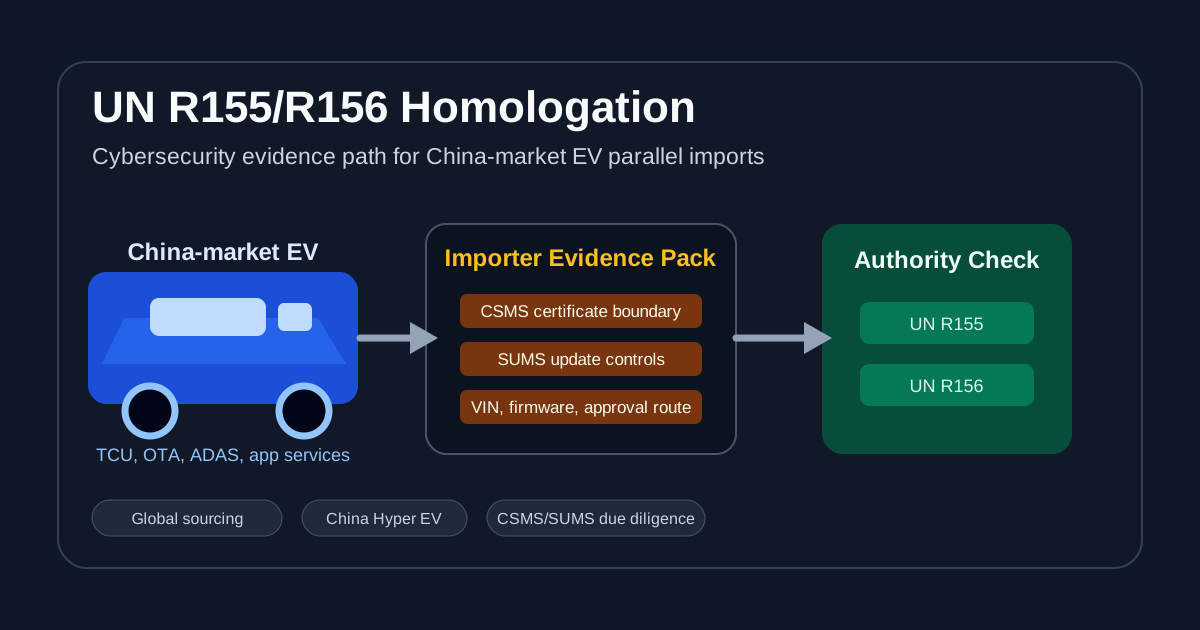
When a parallel importer brings a domestic-market Xiaomi SU7, Zeekr 001, or BYD Yangwang U9 into Europe, the homologation authority requires proof that the vehicle's software lifecycle is secure. The problem? The importer is not the OEM and does not hold the OEM's CSMS certificate.
CSMS & SUMS Regulatory Boundary (Parallel Imports)
Fig 1: The regulatory disconnect between domestic OEM architecture and destination market homologation authorities.
The Three Paths to Homologation for Distributors
When importing EVs without official OEM support in the destination market, procurement teams must choose one of three engineering pathways to achieve legal roadworthiness regarding cybersecurity.
1. The "Air-Gap" Strategy (Hardware Isolation)
The simplest way to bypass UN R155/R156 is to prove the vehicle is incapable of receiving remote software updates or communicating externally.
- Method: Physically removing or disabling the Telematics Control Unit (TCU) and the eSIM module.
- Pros: Can narrow the cybersecurity evidence burden if the destination authority accepts the vehicle as genuinely offline.
- Cons: Cripples the vehicle. Features like remote climate control, live navigation, app connectivity, and active ADAS features will fail. For a premium Hyper EV, this destroys the customer value proposition.
2. The Local Proxy CSMS (Third-Party Validation)
Some advanced distributors partner with independent European engineering firms (like Applus+ IDIADA or local TÜV branches) to certify a "proxy" CSMS.
- Method: The importer creates an isolated, secure server environment to manage software patches locally. The vehicle's firmware is intercepted, and the TCU is reprogrammed to look at the importer's servers rather than the Chinese OEM's servers.
- Pros: Maintains vehicle connectivity while satisfying local authorities.
- Cons: Extremely high CAPEX. Reverse-engineering firmware to reroute OTA pathways without triggering the vehicle's internal anti-tamper mechanisms (Secure Boot) is complex and risks bricking the car.
3. Low-Volume Approval Routes (IVA and National Schemes)
In certain regions (like the UK or specific EU member states), low-volume imports may use Individual Vehicle Approval (IVA) or national approval routes instead of full type approval.
- Method: Processing cars one-by-one under personal import or low-volume commercial quotas, which traditionally focus on mechanical safety (lights, brakes, seatbelts) rather than software.
- Pros: Low engineering cost.
- Cons: Unscalable. Limits import volume to tiny numbers per year and can become unavailable if authorities add software evidence requirements to the relevant approval route.
Structural Comparison: Homologation Pathways
| Pathway | Engineering Complexity | Scalability (Volume) | Regulatory Risk in 2026 | Impact on EV Features | Cost per Vehicle |
|---|---|---|---|---|---|
| Air-Gap / Offline | Low (Hardware disconnect) | High | Low | Severe (Loss of App/ADAS) | $200 - $500 |
| Proxy CSMS / TCU Flash | Extreme (Reverse engineering) | Medium | Medium (Requires auditing) | Minimal (Retains smarts) | $4,000+ |
| IVA / Low-Volume Approval | Low (Paperwork plus local inspection) | Very Low (Capped quotas) | High (Rule changes vary by country) | None | $1,000 - $2,500 |
| Official OEM Export | N/A (Handled by factory) | Infinite | Zero | None | OEM Premium |
| Aftermarket Dongle Override | High (CAN bus spoofing) | Medium | High (Often illegal) | Variable | $1,500 - $3,000 |
| Hardware Bypass Box | Medium | Medium | Very High | Degrades over time | $800 - $1,200 |
Distributor Compliance & Procurement Checklist
If you are a B2B buyer assessing a new batch of Chinese EVs for import, use this checklist before finalizing the Letter of Credit. Do not assume the exporter in China understands your local software laws.
If you already have a VIN list, request a pre-RFQ software risk screen before deposit: destination market, vehicle category, model year, TCU firmware status, OTA dependency, and ADAS geofencing should be checked together, not after the cars arrive.
- 1. Identify TCU Firmware Lock: Can the Telematics Control Unit be localized, or is the Secure Boot locked to the domestic Chinese carrier network?
- 2. Assess OTA Necessity: Does the specific model suffer from critical bugs in its factory firmware that require an OTA update within the first 6 months? If so, the Air-Gap strategy is invalid.
- 3. Consult Local Type Approval Authority: Confirm if your specific country currently requires UN R155/R156 documentation for Individual Vehicle Approvals, or only for Type Approvals.
- 4. Verify Component-Level Certifications: Ask the supplier if critical ECUs (like the braking controller) have underlying ISO/SAE 21434 compliance, which can speed up local auditing.
- 5. ADAS Geofencing Check: Ensure that disabling the TCU (Air-Gap) will not automatically disable local safety features like Lane Keep Assist (LKA) or Autonomous Emergency Braking (AEB), which are required for NCAP ratings.
- 6. Contractual Liability Shift: Ensure your purchasing contract with the Chinese trading company explicitly outlines who bears the cost if the vehicle fails destination-port homologation due to software locks.
Frequently Asked Questions (FAQ)
Q: Can we just use a VPN router in the car to trick the OEM servers into providing OTA updates? A: No. While this circumvents geofencing (allowing the car to talk to Chinese servers), it completely violates UN R156. The local transport authority requires proof that updates are locally managed, tested for safety, and compliant with local data privacy laws (GDPR). Fetching direct updates from uncertified foreign servers is grounds for registration revocation.
Q: Are commercial vehicles (trucks, vans) also subject to UN R155/R156? A: Yes. The regulations apply to vehicle categories M (passenger cars), N (goods vehicles), and O (trailers equipped with at least one electronic control unit). Electric commercial fleets must comply.
Q: If we import the car as "Used" (with 100km on the odometer), does it bypass the regulation? A: Do not assume it does. If the vehicle is being registered for the first time in the target jurisdiction, the authority may still require cybersecurity and software-update evidence, regardless of its foreign registration or odometer history.
Q: Does ISO/SAE 21434 certification equal UN R155 compliance? A: Not exactly. ISO/SAE 21434 is an engineering standard that provides the methodology for cybersecurity. UN R155 is the legal requirement. Having ISO 21434 processes makes passing the UN R155 audit significantly easier, but the audit itself is still mandatory.
Conclusion and Next Steps
The era of shipping an EV across the world and simply plugging it in is over. Software homologation is now just as critical as crash testing. For parallel importers, the decision between Air-Gapping vehicles (sacrificing features) and investing in local Proxy CSMS engineering (high capital expenditure) will define who survives in the premium EV import market.
To avoid millions of dollars in stranded inventory at destination ports, importers must integrate software homologation checks into their initial procurement phase.
For deep technical consulting on TCU localization, proxy CSMS architecture, or destination-market homologation strategies for Chinese EV imports, contact our engineering support team at [email protected].