
Verify eligibility before price
No VIN-specific US certification is established here. Obtain the manufacturer label or a documented import route before committing funds.
Use this AVATR 11 USA checker to model an ocean-entry budget. Eligibility must be documented before shipment.
Required. Excludes separately stated international freight and insurance; broker must confirm assists and other adjustments.
Range: 10,000–300,000; up to 2 decimal places.
Default example only. Other duties remain unconfirmed; temporary-entry costs differ. No import or road-use approval.
Review inputs & purposeReviewed 2026-10-25 · FY2027 MPF · Manual assumptions · Instant local calculation
All numeric fields are required scenario assumptions; zero is accepted where the range permits it. Costs always model an ordinary ocean consumption entry. Changing purpose updates the documentary assessment, without claiming temporary-entry tax relief.
This guide has no VIN-specific manufacturer certification or approved RI route for your AVATR 11. A price calculation does not authorize import or registration.
Next step: Before paying a deposit, obtain the certification label, exact model-year eligibility evidence and written EPA/broker clearance. For immediate daily use, compare US-market vehicles below.
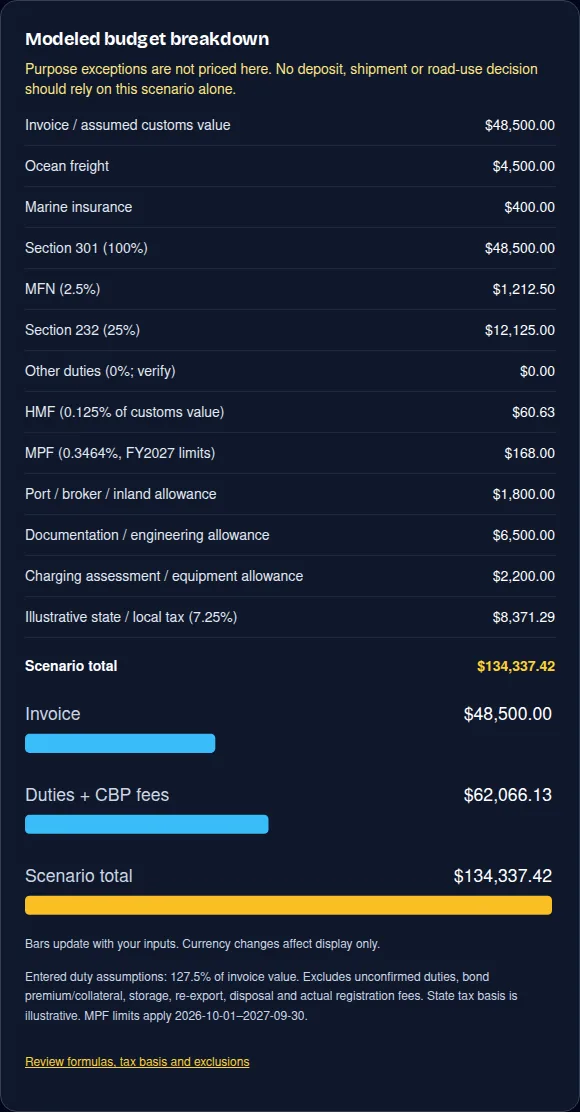
Purpose exceptions are not priced here. No deposit, shipment or road-use decision should rely on this scenario alone.
Entered duty assumptions: 127.5% of invoice value. Excludes unconfirmed duties, bond premium/collateral, storage, re-export, disposal and actual registration fees. State tax basis is illustrative. MPF limits apply 2026-10-01–2027-09-30.
The summary is in USD and includes the purpose, limitations and next step.
No VIN-specific US certification is established here. Obtain the manufacturer label or a documented import route before committing funds.
The 2024 Section 301 measure and MFN baseline omit the 2025 Section 232 auto measure and any other applicable duties. Use entry-date instructions.
This model uses invoice value as customs value; international freight and insurance remain expenditure, without being added to the duty base.
eCFR / CBP: 19 CFR 152.103(a)(1), Example 4 — transaction value
No AVATR-specific US adapter or network validation is established here. Require documented approval for the actual vehicle and equipment.
US Joint Office of Energy and Transportation: Charging connector and adapter compatibility
| Line | Formula / treatment | Evidence or limitation |
|---|---|---|
| Customs value | Invoice assumed to equal adjusted transaction value; exclude separately stated international freight and insurance. | eCFR / CBP: 19 CFR 152.103(a)(1), Example 4 — transaction value |
| Duties | Customs value × each entered percentage / 100. Rates are scenario inputs, including a separate Section 232 line. | USTR / Federal Register: 89 FR 76581 — Section 301 modification CBP: CSMS 64624801 — Automobile import duties |
| MPF | Clamp(customs value × 0.003464, $34.58, $670.86); round to cents. | eCFR / CBP: 19 CFR 24.23 — merchandise processing fees CBP / Federal Register: FY2027 customs user fees, 91 FR 48398 |
| HMF | Customs value × 0.00125 for the assumed ocean import. | eCFR / CBP: 19 CFR 24.24 — Harbor maintenance fee |
| Illustrative tax | (Invoice + freight + insurance + duties + HMF + MPF) × entered state/local rate. Not a statutory tax base for any particular state. | Confirm destination tax base and credits with the authority. |
| Total | Sum invoice, freight, insurance, each rounded duty/fee, user allowances and illustrative tax. | Round each line to cents; currency conversion is display only. |
| Excluded / unresolved | Other duties beyond entered assumptions; bond premium/collateral; storage; disposal; re-export; actual registration fees. | Request a written broker/surety assessment for the entry date. |
These assumptions apply to a battery-electric passenger vehicle. An extended-range (EREV) powertrain may fall under different tariff subheadings. Entering 0% in the other-duty field does not confirm that no additional measures apply. USITC: Live Harmonized Tariff Schedule
| Purpose | Assessment | Next action |
|---|---|---|
| Permanent import for daily road use | This guide has no VIN-specific manufacturer certification or approved RI route for your AVATR 11. A price calculation does not authorize import or registration. | Before paying a deposit, obtain the certification label, exact model-year eligibility evidence and written EPA/broker clearance. For immediate daily use, compare US-market vehicles below. |
| HS-7 Box 7 — temporary research / testing | Temporary evaluation is subject to purpose, importer status and permitted duration. Most non-OEM applicants need advance NHTSA permission; this is not ordinary retail ownership. | Submit the test purpose and disposal plan to NHTSA; verify EPA, BIS, customs and road-test permissions separately before shipping. |
| HS-7 Box 10 — Show or Display | Requires a NHTSA permission letter for the particular vehicle. This page establishes no AVATR 11 approval and cannot predict a petition outcome. | Obtain the actual NHTSA determination and operating restrictions; do not order a vehicle on a seller’s promise of an exemption. |
| HS-7 Box 5 — temporary nonresident personal use | Foreign registration, genuine nonresident status and export within one year matter. Overseas-resident US citizens may qualify; a returning US resident cannot assume this exception. | Ask CBP to confirm residence, duty treatment, bond requirements and documents. Check state operation and insurance before travel; no US sale. |
| Private-track use of a road-manufactured AVATR 11 | An ordinary road-manufactured SUV does not become a Box 8 non-road vehicle because its buyer plans to use private land. Box 1 is the 25-year exemption. | Do not file a non-road declaration for a stock AVATR 11. Ask NHTSA whether a genuine temporary competition or research application is possible. |
| Check | Request | Current limitation | Source |
|---|---|---|---|
| Original conformity | Photograph the manufacturer certification label and match VIN/build date. | Not established for the buyer’s vehicle. | NHTSA: Importation and Certification FAQs |
| RI route | Exact model/year eligibility and written RI agreement, if applicable. | No AVATR eligibility determination is established here. | NHTSA: Importing a vehicle — eligibility and procedures |
| 25-year exemption | Manufacture date, rather than advertised model year. | A vehicle built in 2022 reaches 25 years in 2047; other requirements remain. | NHTSA: Official HS-7 declaration form |
| EPA | Certificate or accepted exemption and correct declaration. | Electric propulsion does not automatically remove EPA requirements. | EPA: Import programs refresher — vehicle Q&A |
| State title and insurance | Written state DMV and insurer requirements for the particular route. | Neither a VIN decode nor a customs payment grants road-use permission. | NHTSA: Importation and Certification FAQs |
This is a document checklist. It does not diagnose failed crash standards, assign a conversion price or claim that NHTSA pre-approves every vehicle. A state registration or LLC cannot substitute for a lawful federal entry basis.
China-spec equipment needs a vehicle-specific compatibility assessment for US use. No charging trial or OEM-approved US combination is established here. US Joint Office of Energy and Transportation: Charging connector and adapter compatibility
| Layer | Issue | Evidence to obtain | Boundary |
|---|---|---|---|
| Connector | China-spec GB/T vs US CCS1 / J3400 equipment | Verify inlet, adapter direction and manufacturer approval. | No supported AVATR-to-US combination established. |
| DC communication | Physical connector fit is only one interoperability requirement. | Obtain protocol and charger interoperability test records. | No tested combination or charge speed established. |
| Battery voltage | Actual voltage window and vehicle charging design depend on variant. | Match charger output range to OEM documentation. | No verified boost-converter or nominal-pack claim made. |
| Home AC | EVSE supply, earthing, onboard charger and protection must match. | Have the OEM and qualified installer confirm the complete system. | No passive-adapter safety or 7 kW guarantee. |
| Network permission | Electrical compatibility does not establish account or network access. | Confirm access with the network for the actual vehicle. | No Supercharger / public-network access assumed. |
| Area | Boundary | Action |
|---|---|---|
| Navigation / assisted driving | US-market feature support and operational domain are unverified. | Do not value the car on promised city navigation or automated driving. |
| Cellular / app / OTA | Carrier roaming, account provisioning and regional updates need VIN-specific confirmation. | Ask for written support terms and a local demonstration; do not assume either complete function or total failure. |
| BIS regulation | Final rule applies by model year, covered technology, entity nexus and authorization. | Have counsel assess the actual transaction; a software feature list alone does not decide legality. |
BIS finalized the rule in January 2025 (90 FR 5360). Software and certain manufacturer sales restrictions begin with model year 2027; VCS hardware restrictions begin with model year 2030, or January 1, 2029 for hardware without a model year. The actual entity, technology, transaction and any authorization determine scope.
Do not treat this as a blanket declaration that every model year is already prohibited, or that removing an app establishes compliance. BIS: Connected vehicle final rule announcement
For a buyer who needs a daily driver now, an official US-market vehicle avoids unresolved parallel-import eligibility. Compare local purchase and ownership terms, rather than a China invoice against a US delivered price.
Official US configurator and inventory provide an actionable local comparison.
Compare an itemized delivered quote, selected-model EPA range, local service, insurance and charging arrangements. No live price is copied into this guide.
Open official US configurator & inventoryManufacturer reference checked 2026-10-25. Prices and availability remain with the seller.
These are decision examples, not actual approvals or reported customer cases.
Premise: A returning resident owns a China-spec AVATR 11 and wants ordinary state plates.
Process: Check original certification or an eligible RI route; household-effects treatment does not itself establish safety eligibility.
Decision: Do not ship while eligibility is unresolved. Compare a US-market vehicle and obtain dealer/insurance quotes.
Premise: A laboratory seeks temporary access for a documented research program.
Process: Assess Box 7, EPA and BIS requirements, obtain needed permissions and agree export/destruction terms.
Decision: Possible only under the actual permissions; no automatic approval, fixed duration or retail resale assumed.
Premise: A nonresident intends a temporary visit with a foreign-registered car.
Process: Confirm residence, Box 5 conditions, CBP duty/bond treatment and insurance.
Decision: Conditional temporary use, with export within one year. This model’s consumption-entry costs do not price that exception.
NHTSA: Certification FAQs — temporary nonresident importation
| Topic | Known | Unknown / mitigation | Source |
|---|---|---|---|
| All-in tariff | 100% Section 301 and 25% auto Section 232 have separate published measures. | Applicable entry-date stack, exemptions and other duties are not certified by this calculator. | CBP: CSMS 64624801 — Automobile import duties |
| Bond / collateral | HS-7 Box 3 states a 150% entered-value DOT conformity bond for an eligible RI entry. | Premium, collateral and separate CBP bond terms require a broker/surety quote. No universal 3×CIF charge is assumed. | NHTSA: Official HS-7 declaration form |
| Vehicle certification | Original manufacturer conformity is evidenced by certification labeling. | No VIN-specific US compliance label, destructive-test result or AVATR RI outcome is verified here. | NHTSA: Importation and Certification FAQs |
| Support / warranty | Contract terms and service coverage must be reviewed for the destination. | No US warranty entitlement, automatic voiding, parts lead time or insurance acceptance is promised. | NHTSA: Importing a vehicle — eligibility and procedures |
| Charging | Vehicle, adapter and charger interoperability all matter. | No AVATR US charging trial, low-voltage boost capability or safe home-adapter combination is verified. | US Joint Office of Energy and Transportation: Charging connector and adapter compatibility |
Paying tariffs cannot cure an ineligible import. Budget for delay and a possible decision not to ship. If documentation remains unavailable, the minimum alternative is a local US-market purchase rather than a speculative import deposit.
Prepared and maintained by the China Hyper EV editorial team. First prepared October 25, 2026. We compare the agency documents below with this calculator’s formulas; we have not imported or road-tested an AVATR 11 in the US. This is a planning aid, not a customs ruling or legal opinion.
Content review: 2026-10-25. Each source retains its own publication or effective date. Historical tariff notices are inputs to a scenario, not certification of the current combined rate. Confirm the latest instructions before filing.
Review policy: recheck each October for CBP fee changes, within 30 days of a relevant agency rule change, and before relying on any entry-date assumption. Send corrections through our editorial contact.
eCFR / CBP · Reviewed 2026-10-25
International freight and insurance are excluded from customs transaction value when separately identified. Other valuation adjustments may still apply.
CBP / Federal Register · Effective 2026-10-01
Formal-entry MPF minimum $34.58, maximum $670.86. Recheck for entries outside fiscal year 2027.
eCFR / CBP · Rate and valuation guidance; annual limits superseded by FY2027 notice
Formal-entry MPF rate is 0.3464%, excluding duty, freight and insurance. Apply the separately cited FY2027 limits.
eCFR / CBP · Check at entry
The modeled ocean import carries HMF at 0.125% of cargo value. Applicability and exemptions depend on the movement.
USTR / Federal Register · 2024-09-18; EV increase effective 2024-09-27
Established a 100% additional duty for covered Chinese EVs. This measure alone does not describe the complete current tariff stack.
CBP · 2025-04-02; effective 2025-04-03
Introduced an additional 25% automobile duty, including covered 8703.80.00 vehicles. Entry-specific exceptions and later changes must be checked.
USITC · Use the revision applicable on the entry date
Broker must confirm the BEV subheading, MFN rate, Chapter 99 measures, origin, exclusions and stacking. EREV vehicles require a separate classification.
NHTSA · Official reference form; obtain current form before filing
Box 1: 25-year age exemption; Box 3: eligible RI conversion; Box 5: nonresident; Box 7: temporary research/testing; Box 8: originally non-road; Box 10: Show or Display.
NHTSA · Reviewed 2026-10-25
Manufacturer certification labels establish original FMVSS conformity. A VIN lookup cannot establish conformity; intended private-track use does not change original road-vehicle manufacture.
NHTSA · Check exact model year before purchase
For a nonconforming vehicle, verify the actual import eligibility or exemption before shipping. This guide does not establish AVATR eligibility.
NHTSA · Reviewed 2026-10-25; confirm CBP duty treatment separately
Nonresidents, including US citizens living abroad, may temporarily import a foreign-registered vehicle for personal use for up to one year, without US sale. Confirm customs treatment separately with CBP.
EPA · 2023-05
Road-going electric vehicles still require EPA certification and an import declaration unless a valid exception applies. Confirm the appropriate declaration with EPA.
BIS · 2025-01-14; final rule 90 FR 5360
Covered software and certain manufacturer sales restrictions begin MY2027; VCS hardware restrictions begin MY2030, or 2029-01-01 without a model year. Authorizations and scope matter.
US Joint Office of Energy and Transportation · Reviewed 2026-10-25
Adapter compatibility is specific to the vehicle and charger. Follow manufacturer instructions; connector fit does not establish interoperability or network access.
Do not purchase on the assumption of ordinary US registration. This guide establishes no VIN-specific US manufacturer certification or approved conversion route. Obtain the actual documents before paying.
Use the actual manufacture date. For example, a vehicle built in 2022 reaches 25 years in 2047. This safety exemption does not itself settle EPA, customs, BIS or state requirements.
Box 10 covers Show or Display and requires a NHTSA permission letter. No AVATR 11 approval is established here; do not assume a successful petition.
Private-track intent does not make a road-manufactured SUV a vehicle originally manufactured for non-road use. Box 8 is not a general workaround. Ask NHTSA about a genuine temporary application.
No. Box 7 has importer and purpose restrictions. A non-OEM generally needs NHTSA permission before import; EPA and other agency requirements remain separate.
NHTSA guidance includes US citizens resident abroad. Residence and the temporary-use conditions matter; citizenship alone is not the test. Ask CBP to confirm the specific entry.
NHTSA: Certification FAQs — temporary nonresident importation
Road-going electric vehicles still have certification and declaration requirements unless an accepted exception applies. Do not select an EPA exemption code based solely on the absence of an engine.
No. A VIN decode cannot establish original FMVSS conformity. Inspect the manufacturer certification label and the actual import documents; do not infer either approval or rejection from a database lookup alone.
No. That baseline combines 100% Section 301 and 2.5% MFN, omitting the separate Section 232 automobile measure and potentially other duties. Have a broker confirm current classification, stacking and exclusions.
CBP valuation excludes separately identified international freight and insurance from transaction value. The model assumes the invoice is the adjusted customs value. Freight and insurance are still included in expenditure.
eCFR / CBP: 19 CFR 152.103(a)(1), Example 4 — transaction value
FY2027 limits: $34.58 minimum and $670.86 maximum, effective October 1, 2026. The modeled formal-entry rate is 0.3464%. Recheck limits for a different fiscal year.
CBP / Federal Register: FY2027 customs user fees, 91 FR 48398
No universal 3×CIF rule is assumed. For the eligible RI route, HS-7 Box 3 specifies a DOT conformity bond of 150% of entered value. Bond face value, premium and collateral are different items; obtain a route-specific quote.
No. This model applies your illustrative rate to invoice, transport, modeled duties and CBP fees. State and local taxable bases, exemptions and registration fees differ. Confirm with the destination authority.
No. The cost panel always models an ordinary ocean consumption entry. Temporary-entry relief, bonds, export and disposal costs need separate assessment; the purpose selector changes the documentary checklist only.
NHTSA: Certification FAQs — temporary nonresident importation
Connector fit alone is insufficient. Vehicle and charger interoperability, safety approval and network permission must all be established. No AVATR-specific US adapter combination is verified here.
US Joint Office of Energy and Transportation: Charging connector and adapter compatibility
This guide does not establish a safe home setup. Obtain OEM approval for the precise onboard charger, EVSE and adapter combination and have a qualified installer confirm the supply and protection.
US Joint Office of Energy and Transportation: Charging connector and adapter compatibility
No. Verify the actual battery charging voltage window, conversion design and charger output range. This page has no verified AVATR boost-converter specification or station-by-station test.
US Joint Office of Energy and Transportation: Charging connector and adapter compatibility
US feature support, carrier provisioning, regional accounts and updates are unverified for the buyer’s vehicle. Require written support terms and an authorized demonstration; do not assign value to unconfirmed features.
No. The January 2025 final rule phases in software and certain manufacturer restrictions at MY2027, and VCS hardware at MY2030 or January 1, 2029 without a model year. Scope and authorizations require transaction-specific review.
Compare a US-market configuration through an official local sales channel. The Porsche Macan Electric US configurator linked below is one starting point; obtain a delivered price and confirm local insurance, warranty and charging.
No coverage is established by this guide. Ask the manufacturer, seller and insurer for written VIN-specific territorial terms. Also request a repair plan and itemized parts and shipping estimates.
Assemble the VIN, build date, certification-label photos, intended import purpose, destination and itemized invoice. Obtain the relevant agency permissions and broker assessment first; otherwise use a local US-market purchase route.
Collect the VIN, manufacture date, certification-label photos, invoice, destination, purpose and proposed entry date. Ask an importer or broker to establish eligibility and the current duty treatment before an export quote becomes a purchase decision.